Hernia Repair in Wesley Chapel, FL
Dr. Sahand Bamarni

Advanced & Minimally Invasive Hernia Repair
A hernia occurs when an internal organ or tissue pushes through a weak spot in the surrounding muscle or connective wall. While hernias do not heal on their own, modern surgical advancements have transformed treatment into a safe, routine, and highly effective process. Dr. Sahand Bamarni provides comprehensive hernia evaluations and offers individualized treatment plans ranging from traditional approaches to state of the art minimally invasive and robotic assisted techniques to deliver superior results, and optimal recovery times.Inguinal & Groin Hernias
Inguinal hernias are the most common type of hernia, occurring when tissue or a portion of the intestine protrudes through a weak point in the lower abdominal wall or groin channel. Patients often notice a visible bulge alongside a dull ache, pressure, or sharp pain that worsens when lifting, bending, or coughing.
Ventral & Incisional Hernias
Ventral hernias develop along the front wall of the abdomen, while incisional hernias specifically occur at the site of a prior surgical incision where the abdominal wall may have weakened over time. Precise surgical restoration rearranges and reinforces the abdominal wall layers to rebuild core stability and prevent future recurrence.
Umbilical Hernias
An umbilical hernia forms near or through the belly button, caused by a weakness in the abdominal muscle ring where the umbilical cord attached before birth. It can become tender under pressure or physical exertion. Modern repair methods quickly repair the defect through tiny, discrete incisions to restore the natural appearance and strength of the abdominal wall.
Hiatal & Paraesophageal Hernias
Unlike external hernias, a hiatal hernia occurs inside the chest cavity when the upper portion of the stomach slides upward through the diaphragm. It can cause severe heartburn, chest discomfort, acid reflux, or difficulty swallowing. Specialized surgical repair repositioning the stomach below the diaphragm and tightening the esophageal opening effectively resolves chronic reflux symptoms and prevents dangerous complications.
Tailored Repair Options: Robotic & Minimally Invasive Care
Every patient's anatomy and lifestyle require a customized surgical approach:

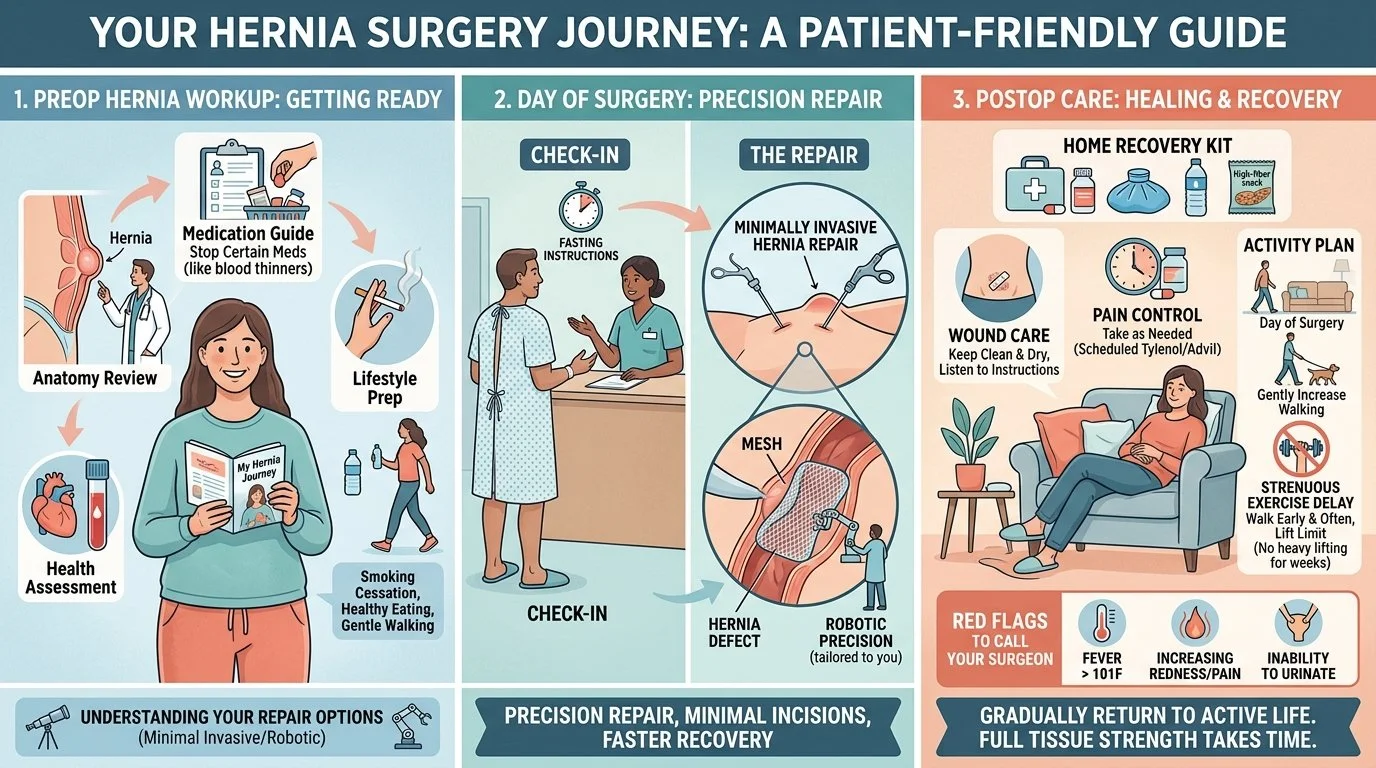
Robotic-Assisted Hernia Repair: Utilizing high-definition 3D visualization and wristed instrumentation, robotic technology allows for unparalleled surgical precision, smaller incisions, reduced post-operative pain, and faster overall recovery.

Minimally Invasive (Laparoscopic) Surgery: Small keyhole incisions allow for rapid healing, lower infection risks, and minimal cosmetic scarring compared to traditional open procedures.

Tailored Patient Plans: Whether your condition requires a minimally invasive approach or a complex open reconstruction, your surgical plan is tailored specifically to your health profile, activity level, and long-term wellness goals.